
Arrest Warrants in West Hartford County
In Connecticut, an arrest warrant is a judge's order, not a police list. General Statutes §54-2a sets the path: a proper criminal application, a probable-cause showing, and review by a judge or other authorized judicial authority. Once signed, the warrant lets an officer arrest the named person for the offense it describes. Where does West Hartford County fit? Criminal matters route through Connecticut Superior Court. Geographical Area No. 14 at Hartford handles the local lower-level criminal and motor-vehicle docket, while Hartford Judicial District takes broader Superior Court matters. There is no West Hartford municipal criminal court, and no Hartford County sheriff roster serves this work. So the practical step is to identify the issuing court and the assigned agency rather than hunt for a town warrant office that Connecticut's structure simply does not have.
Probable Cause for West Hartford Arrest Warrants
Probable cause is the hinge of every West Hartford arrest warrant. The application or affidavit lays out the facts, and the issuing authority decides whether the standard required by §54-2a is met. If it is, the warrant authorizes arrest on its own terms. The allegations themselves get sorted out later, in a court proceeding where the person's rights apply. For the source law, read Connecticut Chapter 959. Its statutory language explains who may issue the process and what foundation it demands, though it offers no individual West Hartford County arrest warrant lookup. The OPM plain-language arrest-warrant article walks through the agencies involved and the limits of OPM warrant data, which is a useful companion to the statute itself.
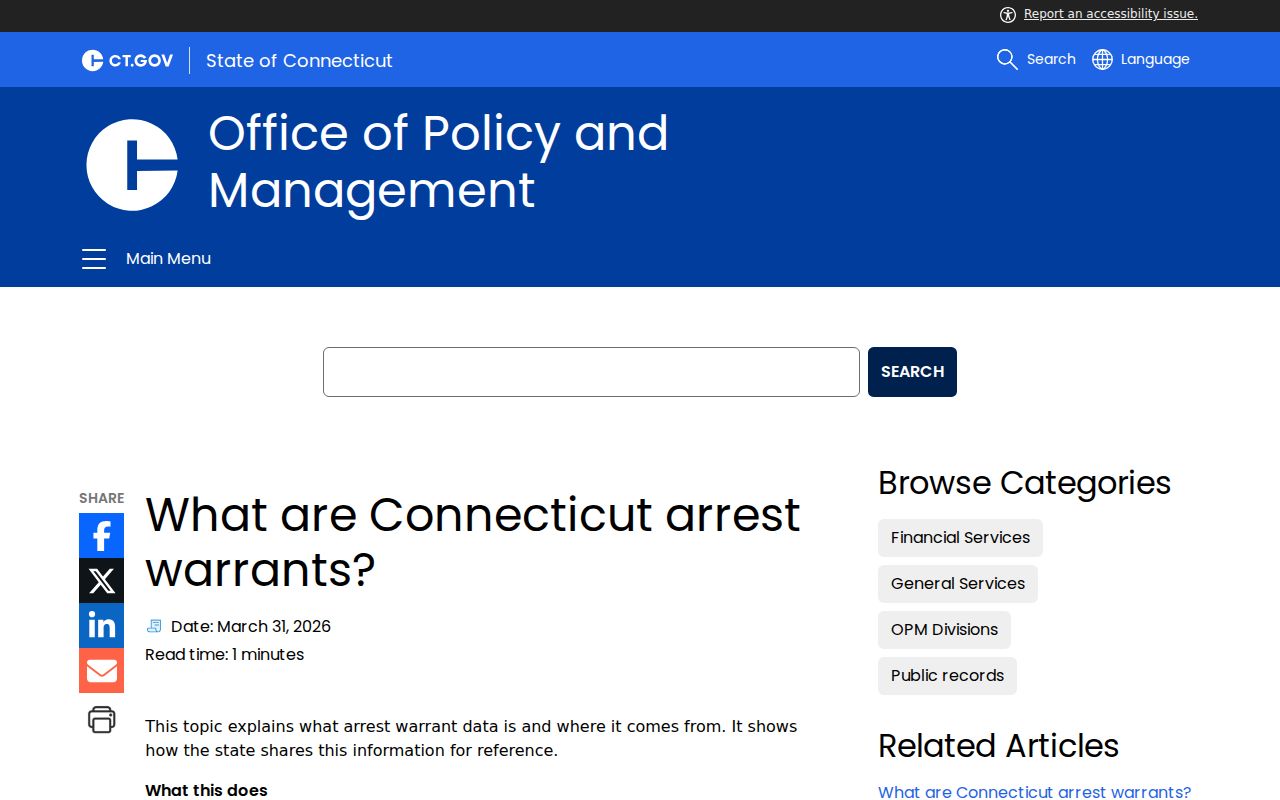
The same OPM article also separates OPM's data-publication role from the court's power to issue or change a warrant in West Hartford County.
What a West Hartford County Arrest Warrant Contains
What might a West Hartford County arrest warrant actually contain? The public state interface promises no uniform result sheet. Depending on the category and what disclosure the law allows, a court or police record may list various fields. Treat conditional items as things to confirm with the clerk, since sealed or redacted information can be withheld.
| Name or identifier | A name match, birth year, or other identifying detail when lawfully displayed. |
|---|---|
| Warrant type and status | The process category and whether the source reports it as issued, active, or served. |
| Court reference | The issuing court, court location, docket reference, or date context. |
| Alleged offense | An offense classification or charge where the record permits disclosure. |
| Agency record | A WHPD report number, incident or arrest date, and serving-agency notation when present. |
| Bond or release | Conditional court-set information that must be checked through the authorized process. |
West Hartford County publishes no single public warrant-number format. Do not guess at a sample number. Instead, give the clerk any real docket or agency number printed on your own papers.
Public Arrest Records and Sealed Affidavits
Connecticut General Statutes §1-215 governs public arrest records. After a warrant arrest, the releasable record may include the warrant application and affidavit, unless the court sealed them. Even then, access is not absolute. Active-investigation concerns, witness or victim protection, prospective enforcement, confidential techniques, juvenile records, and other statutory limits can all justify withholding or redaction. The broader Connecticut Freedom of Information Act opens with public access under §1-210(a), while §1-210(b)(3) lists the law-enforcement exceptions. Requesting records on a West Hartford County matter works best when the request is narrow. Name the incident or report, give a reasonable date range, ask for an electronic copy when that fits, and request the statutory reason for anything withheld.
How West Hartford County Arrest Warrants Are Served
Service of a West Hartford County arrest warrant belongs to authorized officers only. WHPD's Investigative Services page states that detectives serve warrants and make criminal arrests, and its Emergency Services Unit may handle warrant service involving weapons. Those published roles tell you who may act locally, nothing more. The department posts no warrant roster, service schedule, or tactical details. Never approach a person or try to carry out court process yourself. The official WHPD Investigative Services page documents the Detective Division's role.
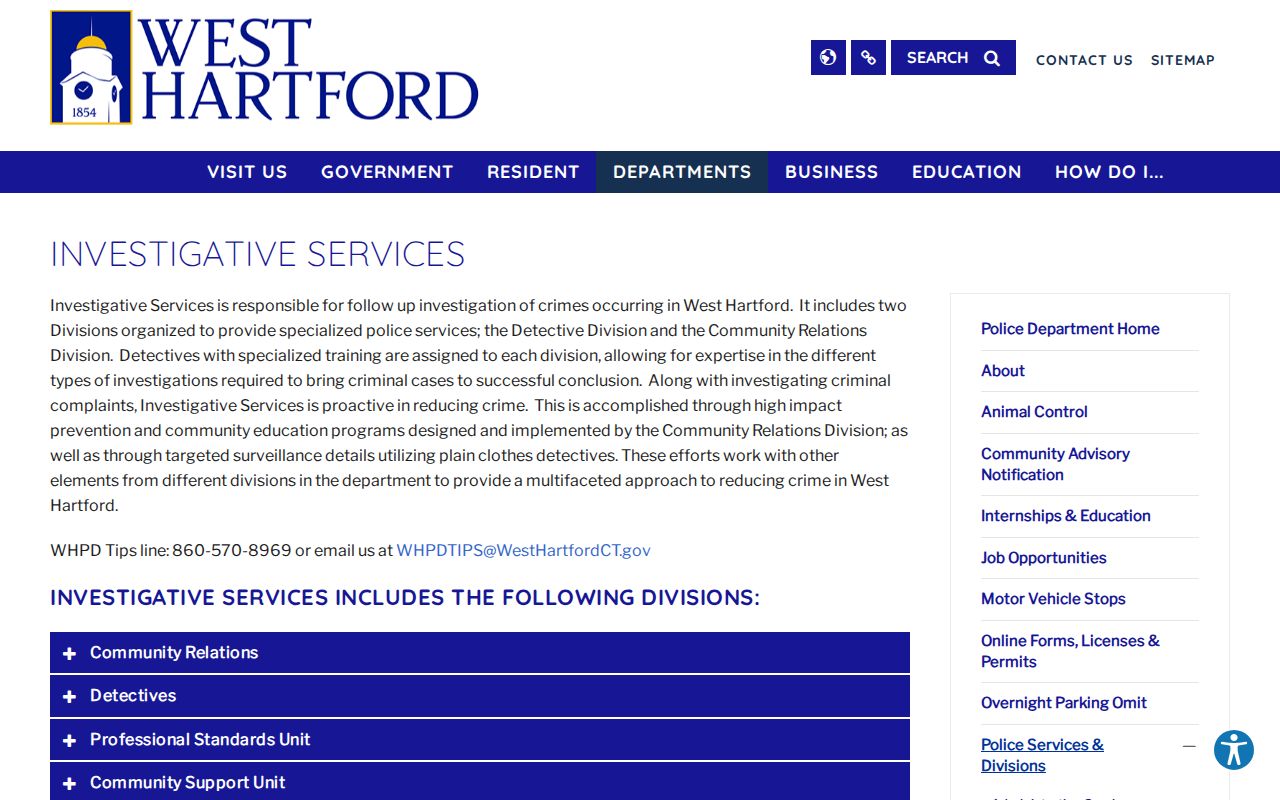
That local channel ends at the arrest itself. Booking, court presentation, and release decisions then follow the lawful process. General Statutes §§54-64a and 54-64b govern the release framework, including release after arrest on a court warrant. Any bond amount or conditions in a West Hartford County case come from the court or an authorized release official, never from a generic estimate.
Issued and Served Mean Different Things
The Judicial Branch glossary draws a line worth knowing. An active warrant is authority for an officer to arrest the named person. Issued means the judge or authorized authority created it. Served means the person was arrested or processed on it. These points can fall at different times, so an online entry may lag behind a service attempt, recall, seal, correction, or update in West Hartford County.
That sequence is why a search result is only a signal. Someone checking their own West Hartford County arrest warrant status should ask GA14 or the originating clerk what the docket shows today. WHPD can speak to its own releasable police records, but OPM aggregate data cannot resolve a personal warrant.
Arrest Warrant vs Summons vs Bench Warrant
Not every court paper does the same job in West Hartford County. A summons just tells you to show up. A bench warrant comes after a missed court date or a broken court order. An arrest warrant, by contrast, rests on probable cause for an offense and directs police to take a person into custody. A search warrant is separate again: it permits a search for listed evidence, not an automatic arrest.
| Feature | Arrest Warrant | Summons | Bench Warrant |
|---|---|---|---|
| What it directs | Arrest of the named person | Appearance at the stated time | Arrest tied to a missed court duty |
| Basis | Required probable-cause showing | A command to answer the matter | Existing docket or court order |
| Next step | Confirm surrender, release, and bond instructions | Appear as directed | Ask the issuing court about appearance or recall |
| Public search | No complete West Hartford roster | May appear in case records | Some FTA records may appear |
West Hartford Records and Detectives Have Separate Roles
In West Hartford County, WHPD Records and the Detective Division answer different questions, so ask each one within its lane. Records keeps incident, arrest, and accident files that state law allows it to release. You can send a written Connecticut FOIA request by email, mail, or drop-off. The office sits at 103 Raymond Road, answers 860-570-8800 and PDRecords@WestHartfordCT.gov, and keeps weekday hours of 8 a.m. to 4 p.m. Copies cost $0.50 per page, plus $1.00 if you want one mailed. Detectives serve arrest warrants; their line is 860-570-8870. That number is for routing a matter to the right place, not a public warrant-status hotline. Records cannot recall a court warrant either. So split your calls: the clerk for the order and docket, Records for a defined releasable police file, and Detectives only when the court or department directs you there.
What to Do If There's a Warrant for You
If you suspect an active warrant in West Hartford County, start with the partial Judicial Branch FTA/VOP/OTI search, then keep going. Call GA14 at 860-566-1630, or the originating Superior Court clerk, to confirm the current status of any outstanding warrant. Ask what appearance, motion, surrender, and release process applies. A lawyer can weigh whether voluntary surrender, posting an authorized bond, or moving to recall or quash the warrant fits your docket. If surrender is directed, nail down where and when to report, what identification and papers to bring, whether counsel may join you, and how release gets considered. WHPD publishes no walk-in surrender window. And skip 911 for a routine status question. Reserve 911 for an immediate threat to a person or property.
Important: Speak with counsel and the issuing court before surrender; do not rely on a partial search or an assumed bond amount.
State and Federal Arrest Warrants Use Different Channels
Searching Connecticut Superior Court records, or anything in West Hartford, will not tell you whether federal process exists. Federal warrants and complaints run through the U.S. District Court for the District of Connecticut and federal law enforcement. The Hartford federal clerk sits in the Abraham A. Ribicoff Federal Building and lists 860-240-3200. Service on a federal warrant may involve the U.S. Marshals Service. Keep each tool in its lane too. PACER opens federal dockets; it is not a universal federal warrant search. Connecticut's FTA/VOP/OTI page is likewise not a complete state or local arrest-warrant database. For state process, use GA14, the originating Superior Court clerk, and the relevant WHPD channel. For federal process, use federal counsel, the federal clerk, or the agency holding the matter. The West Hartford County warrant records overview maps where each source stops and starts.