
Bench Warrants in West Hartford County
Connecticut courts use bench-warrant language for process issued after someone ignores a court command. The classic trigger is a missed required appearance. When that is the setting, the more precise label is a failure-to-appear warrant, often written as FTA warrant. Violation-of-probation process and an Order to Incarcerate stand as separate categories. In any single West Hartford County case, the docket, the judge's order, and the statute behind it tell you what the paper means. Structure is the local fact that matters most. West Hartford has no municipal criminal court for ordinary criminal warrants. Criminal and motor-vehicle cases go to Connecticut Superior Court, with Geographical Area No. 14 at Hartford carrying the local lower-level docket. A town parking citation portal will not work as a bench-warrant search. And the lack of a town court in West Hartford County does not mean court process cannot exist.
GA14 Starts a West Hartford Bench Warrant Check
Call the criminal clerk at Hartford GA14, 101 Lafayette Street in Hartford, at 860-566-1630, with any West Hartford County bench warrant question. The clerk can confirm whether GA14 holds the matter, explain what the docket reflects today, and lay out the proper court-controlled next step. Hartford Judicial District handles higher-level criminal matters as well, so identify the originating court rather than guess. For a first pass, the public FTA/VOP/OTI warrant search is a useful screen. Search by last name and narrow by WEST HARTFORD or Hartford GA 14 when that helps. The Judicial Branch cautions that the tool does not contain all warrant types. A blank result is not a certificate that no West Hartford County bench warrant exists. The official court page displays the interface itself, along with its narrow scope.
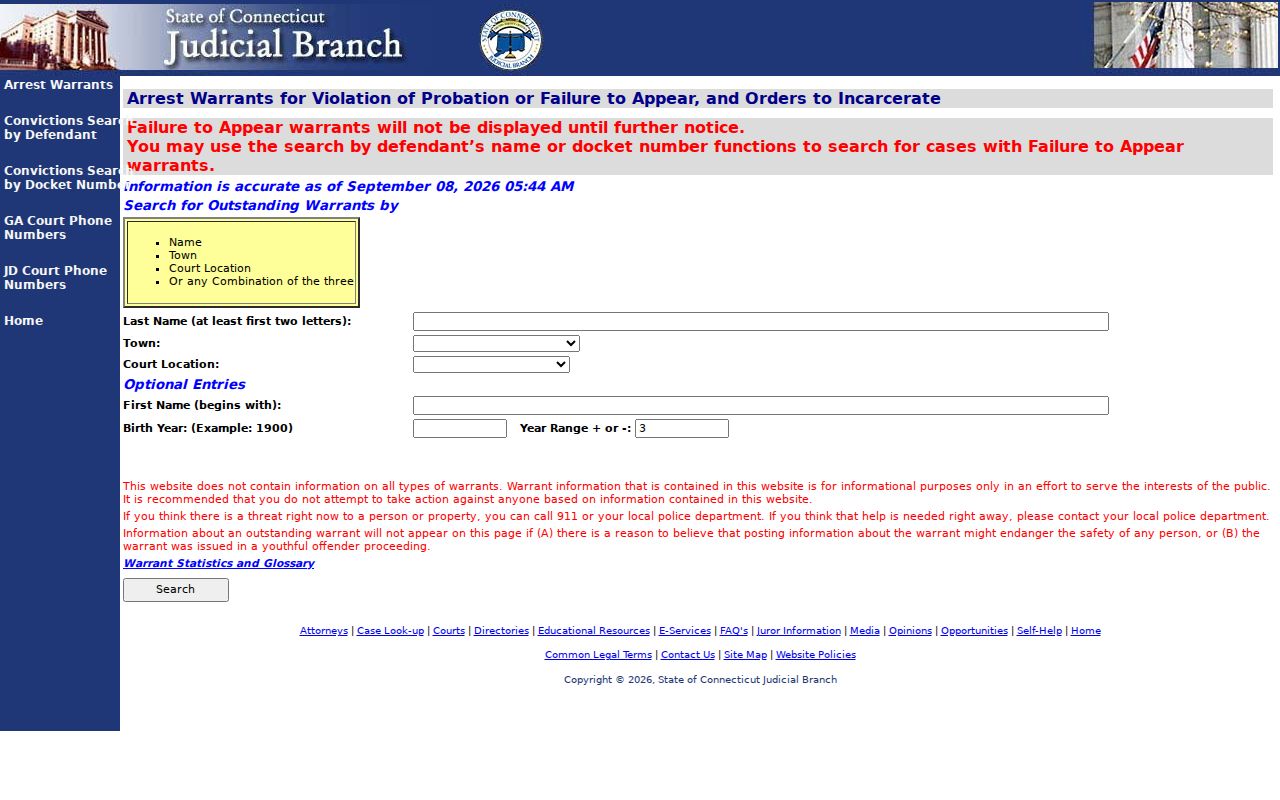
The town and court filters can narrow a West Hartford County warrant check, but only the clerk's office can give current court confirmation on an active warrant.
How a Bench Warrant Is Issued
General Statutes §54-2a lets a Superior Court judge, or another authorized judicial authority, issue bench warrants or capias process when the law allows it, including after someone disobeys an order about appearance. Once issued, an active warrant permits a law-enforcement officer to arrest the named person. Issuance is not service. The Judicial Branch glossary uses served to mean the person was arrested or otherwise processed on the warrant. PRAWN, Connecticut's Paperless Arrest Warrant Network, supports organized law-enforcement agencies. It is not a complete public roster of West Hartford County bench warrants. The public FTA/VOP/OTI tool exposes only defined categories. Court files, restricted matters, and police systems each give a different view, so no single source shows everything.
The §54-2e West Hartford FTA Timing Rule
General Statutes §54-2e adds a timing protection around an alleged failure to appear. A rearrest warrant or capias generally may not issue before 4 p.m. on the date of the alleged failure, unless good cause supports earlier action. That rule governs when process may issue. It does not cancel an issued West Hartford County bench warrant, and it creates no open-ended grace period. The full language sits in Connecticut Chapter 959. Read it to understand the court's authority, not to calculate personal status without a docket. The statute itself shows why warrant, bench warrant, and capias must be read in context.
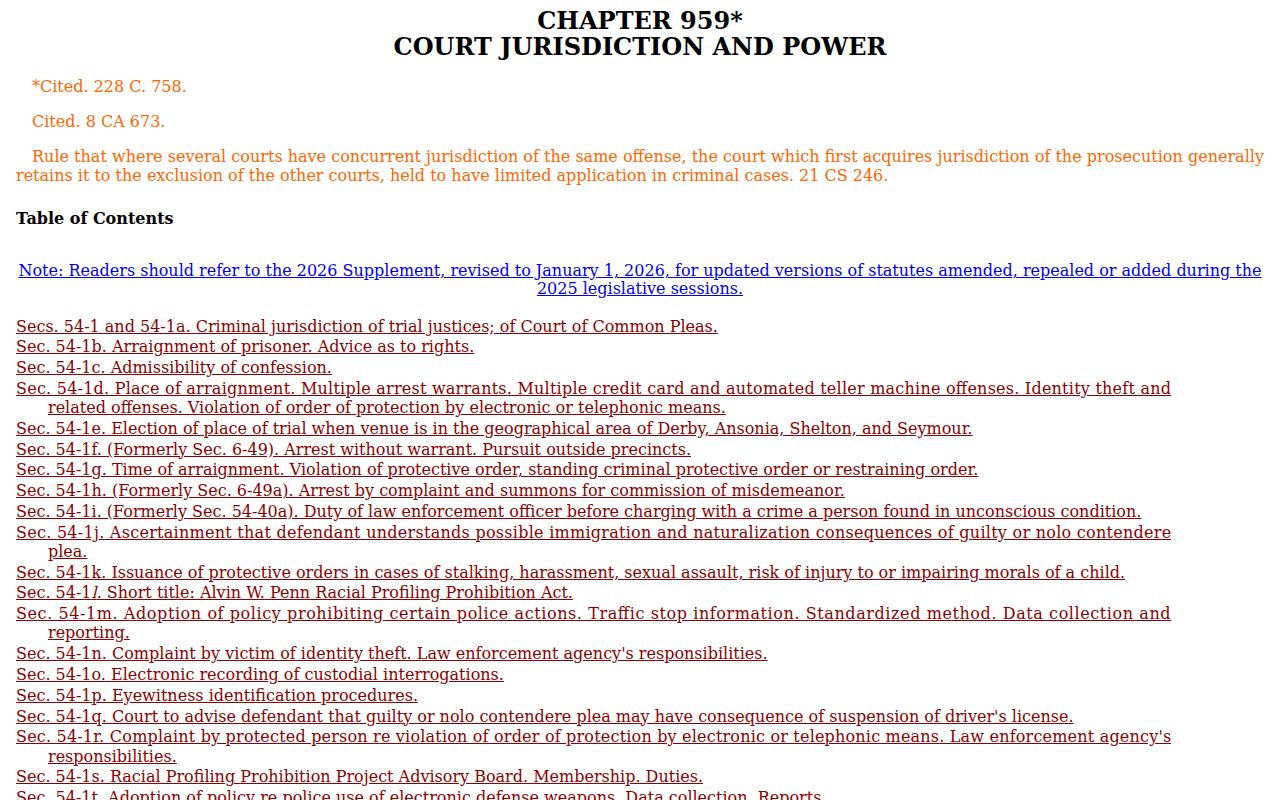
The statute explains legal process but does not publish names or live warrant status.
Bench Warrant vs Arrest Warrant
Both papers authorize an arrest, but they travel different roads. A bench warrant usually grows out of a court obligation that already exists. An arrest warrant rests on a probable-cause showing for an alleged offense. Connecticut labels can overlap, so trust the court record over casual wording, and see the companion detail on West Hartford County arrest warrants.
| Feature | Bench Warrant | Arrest Warrant |
|---|---|---|
| Typical basis | Missed appearance or failure to follow an order | Probable cause for an alleged offense |
| Case setting | Usually an existing docket | May begin or advance a criminal case |
| Public view | Some FTA records may appear | No complete public local roster exists |
| Response | Ask about appearance or recall | Ask about surrender, release, and bond |
West Hartford Bench Warrant Labels Can Mislead
Bench warrant, FTA warrant, rearrest warrant, and capias are not one fixed event. FTA points to an alleged missed appearance in a criminal, motor-vehicle, or infraction case. VOP concerns an alleged probation violation. OTI is an order tied to an unpaid fine or an unserved prison sentence. Capias appears in specified Connecticut statutory settings, so do not assign it another state's meaning when reading a West Hartford County warrant.
- Issued
- The authorized court created the process; it may not yet be served.
- Active
- The warrant authorizes law enforcement to arrest the named person.
- Served
- The person was arrested or processed on the warrant.
- Recalled or disposed
- The court took action shown by an order, docket update, receipt, or other proof.
Using the docket's exact label helps GA14, counsel, and WHPD route a question correctly. It also keeps one West Hartford County bench warrant from being flattened into the wrong category.
How to Resolve a West Hartford County Bench Warrant
There is no universal clearing button and no published West Hartford walk-in program. Recall sits with the issuing court alone. Confirm the matter before appearing, and consider counsel where arrest, bond, probation, or a disputed absence may be involved.
- Use the partial state search and known docket facts to identify the likely court and category.
- Call GA14 or the actual originating Superior Court clerk for current status and instructions.
- Ask whether counsel should file a motion and whether a personal appearance is required.
- If surrender is directed, confirm the place, time, papers, and authorized bond process.
- Keep a stamped order, receipt, release paper, docket update, or clerk confirmation.
Caution: Do not ignore a confirmed warrant or rely on a blank public search; get current instructions from the issuing Superior Court.
When a West Hartford Case Search Finds No Warrant
A pending-case search can point you to the right court without telling you anything firm about warrant status. The name search wants the defendant's full name. The docket search wants court, case type, year, number, and suffix. Those tools answer a different question from the limited warrant page. A pending docket does not prove that a West Hartford County bench warrant is active or inactive. Once you have the likely court, hand the clerk whatever identifying details the office asks for. Never act against another person on the strength of an online match. The Judicial Branch itself warns that public information can be incomplete and should not be used as a basis to act against anyone. Restricted records add one more limit. A youthful-offender warrant may never reach the public warrant page, and juvenile matters are protected under General Statutes §46b-124. Sealing and law-enforcement exemptions can also block access. A blank result means only that the public tool showed no match under those inputs. It does not certify that every West Hartford County court and police source sees no warrant.
Which West Hartford County Court Issued It
Where the case sits depends on its type. Local criminal and motor-vehicle bench matters usually route to GA14 at 101 Lafayette Street. More serious charges may land in Hartford Judicial District. Family and support cases sit apart at 90 Washington Street, where the family clerk can be reached at 860-706-5100 and support enforcement at 860-706-5110. A municipal parking portal or Town Hall handles no criminal dockets. West Hartford County police serve warrants, but WHPD detectives cannot recall one; the court keeps that power, though detectives may steer you at 860-706-5100's court direction via 860-570-8870. WHPD Records, 860-570-8800, holds releasable local files without promising to confirm or clear every court warrant.
Proof a West Hartford Bench Warrant Changed
A paid ticket, a hunch, or an empty search result is weak proof that a West Hartford County bench warrant was recalled. What counts is court paper. Look for a court-stamped order, an updated docket, a receipt tied to the required act, release paperwork, or direct clerk confirmation. Public systems can lag, and files change through correction, sealing, erasure, or other lawful court action. Bond questions belong with the court or the authorized release process. General Statutes §§54-64a and 54-64b set broad release rules, but they do not hand you one amount for all West Hartford County bench warrants. Ask which conditions apply, who may accept payment, and what proves completion. The West Hartford County warrant records overview walks through the wider court and police route. For a local police file, WHPD Records can take a narrow request by email, mail, or drop-off, charging $0.50 per page plus $1.00 for mailing. A released report may carry redactions, and it is no substitute for the court's proof of recall. Keep the police response with your court papers. Rely on the issuing clerk for the warrant's current legal status.